

Search is no longer limited to a list of blue links. AI-powered search is changing how people discover information, compare solutions, and find businesses. For WordPress site owners, the way content is structured and technically delivered now matters more than ever.
Quick Answer
Most WordPress sites were built for traditional search, not AI driven discovery. Knowing how to optimize website for AI search starts with fixing the way your content is structured, accessed, and understood by search systems. Weak content structure, inconsistent entity signals, missing structured data, inaccessible information, and indexing problems can make a site harder for AI systems to retrieve, understand, and reference.
Why Traditional SEO Is Changing
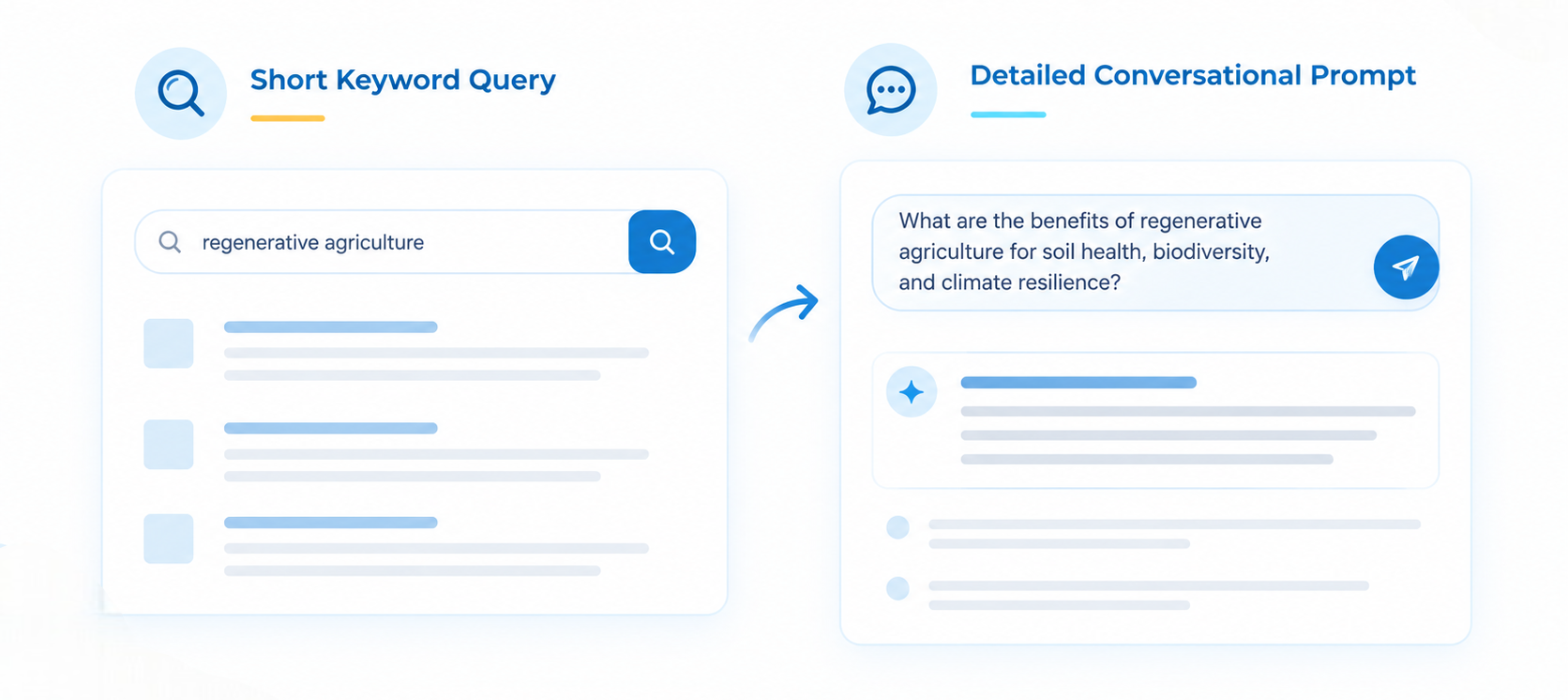
Search is moving from short keyword queries toward conversational questions, but traditional SEO remains the technical foundation underneath that shift.
A user who once searched for “WordPress speed optimization” might now ask:
“My WooCommerce store is slow on mobile even after installing a caching plugin. What should I check first?”
The first query gives a search engine a topic. The second gives it a problem, context, technology, and desired outcome.
Google’s current documentation makes this point directly: its generative AI features still rely on established Search systems and SEO fundamentals. Google also recommends creating unique, valuable content rather than trying to manufacture visibility through scaled content.
The practical implication for WordPress owners is simple. Your website needs to be optimized not only around keywords, but around:
- Questions and search intent
- Entities and relationships
- Context and topical relevance
- Clear content structure
- Information that can be retrieved and understood
The shift toward conversational search
Long tail searches naturally contain more context than traditional keyword phrases.
Compare:
Traditional query:
WooCommerce inventory sync
Conversational query:
How can I automatically sync WooCommerce inventory with my ERP without manually updating stock every morning?
A well structured website can address those concepts together instead of creating a separate thin page for every variation.
That is one of the foundations of generative engine optimization strategies. The objective is not to write content that sounds like it was created for an AI. It is to make your expertise clear enough that both humans and automated systems can understand it.
How AI Search Engines Pull Data Using RAG
Retrieval augmented generation, or RAG, allows an AI system to retrieve relevant information before generating an answer, making discoverability and content quality critical.
A simplified RAG workflow looks like this:
User question → retrieval → relevant sources → context → generated answer
The retrieval stage identifies information that may answer the user’s question.
The system then uses that retrieved information as context for generating its response.
This is fundamentally different from expecting an AI model to simply “remember” your website.
For website owners, the important question becomes:
Can the relevant information on my website be discovered and understood when a system needs it?
That is where technical SEO and content architecture intersect with AI search. Google’s documentation explains that retrieval augmented generation, also called grounding, can retrieve relevant information from Google’s Search index before an AI response is generated.
Different AI platforms use different retrieval systems, but they all depend on information being accessible and understandable.
Why individual passages matter
Traditional SEO often encourages businesses to think about pages as ranking units. AI search makes the information inside those pages more important.
A service page should not merely say:
“We provide custom WordPress development.”
It should explain:
- What the service includes
- Which problems it solves
- Who needs it
- Which technologies are involved
- How it relates to other services
- What outcome the customer can expect
It should explain what the service includes, which problems it solves, who needs it, which technologies are involved, and how it relates to other services. This creates a stronger information structure. It also gives retrieval systems more meaningful passages to work with.
What Makes a WordPress Website Readable for AI?
Making WordPress content readable for LLM bots starts with accessible HTML, logical headings, crawlable links, consistent terminology, and information that does not depend entirely on visual presentation.
A modern WordPress website can contain page builders, JavaScript components, AJAX requests, sliders, filters, tabs, and interactive elements. None of those technologies automatically make a site unsuitable for AI search.
The problem is where the important information lives.
If a critical explanation exists only after an interaction, inside a dynamically generated component, or behind an unnecessary technical barrier, the site’s information architecture becomes more complicated than it needs to be.
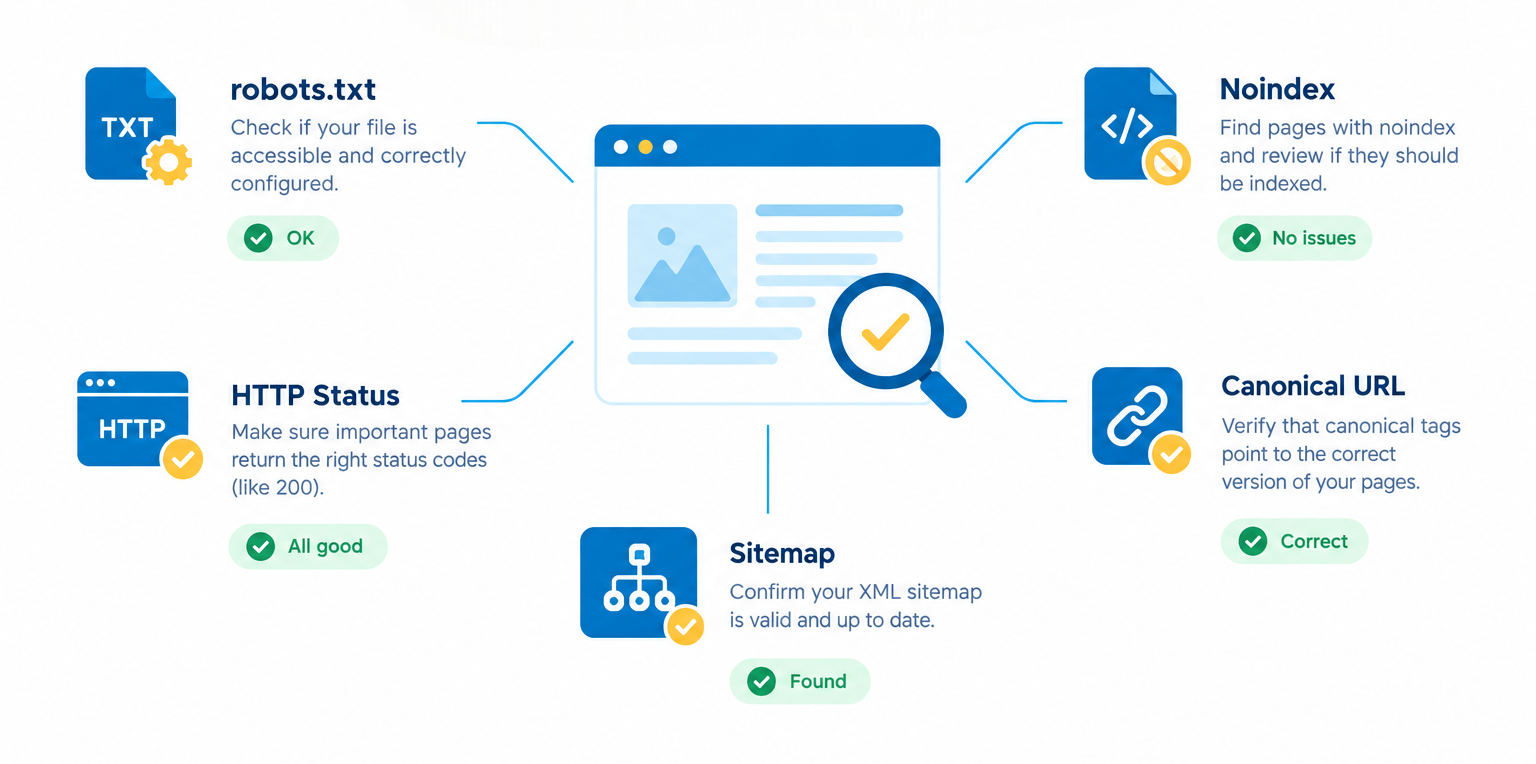
Semantic HTML provides clearer structure:
- Headings establish hierarchy.
- Paragraphs contain explanatory content.
- Lists communicate grouped information.
- Links establish relationships between pages.
- HTML content keeps important information available in the document structure.
Google’s technical requirements also emphasize that pages need to be accessible to Googlebot, return a successful response, and contain indexable content before they can be eligible for indexing.
This is where technical WordPress Development Services can address problems that a standard SEO configuration cannot.
A development audit can examine the actual HTML, templates, rendering behavior, internal links, metadata, custom post types, and integrations behind the visible design.
The goal is not to remove JavaScript. The goal is to ensure that important information is available in a reliable structure.
3 Technical Mistakes That Can Hold WordPress Sites Back
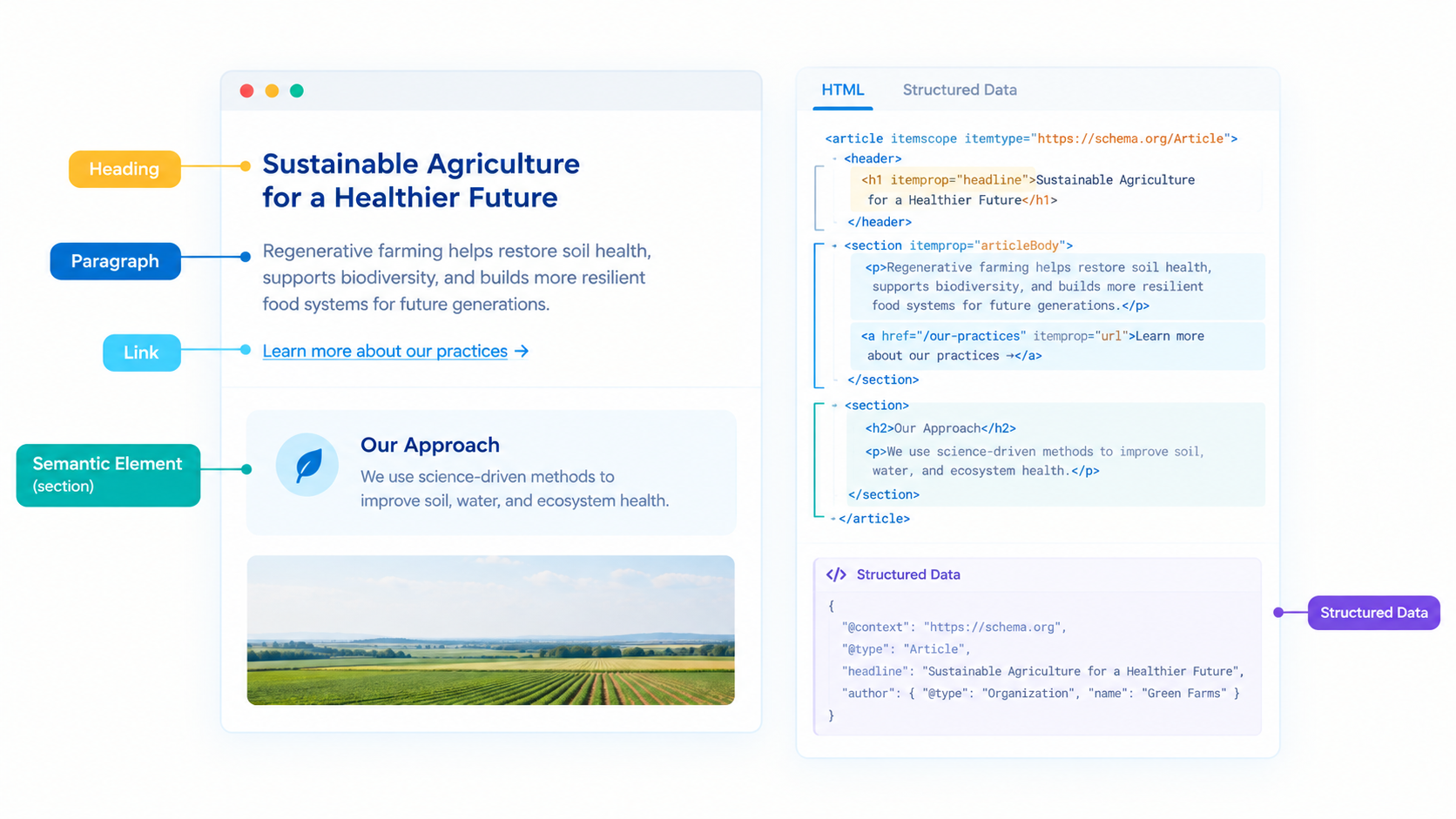
The three problems worth auditing first are inaccessible content, inaccurate or missing structured data, and accidental crawling or indexing restrictions. If you are learning how to optimize website for AI search, these technical issues are worth checking before changing your content strategy.
1. Important content depends too heavily on JavaScript
JavaScript is not inherently bad for search.
Google has been rendering JavaScript for years, and its documentation explicitly states that using JavaScript to load content does not automatically make content harder for Google Search.
For example, a service page might initially deliver six visual cards while the actual descriptions are loaded through interactions or additional requests.
If the core business information is unnecessarily dependent on those interactions, the page becomes harder to inspect, maintain, and process consistently.
A stronger approach is to:
- Keep important content available in the page’s accessible document structure.
- Use JavaScript to enhance the user experience rather than hide essential information.
- Test important pages to confirm that critical content is actually rendered and available.
A stronger approach is to make important content part of the page’s accessible document structure and use JavaScript to enhance the experience.
2. Schema markup is missing, inconsistent, or inaccurate
Schema markup for AI search engines should describe the information that actually exists on the page. Schema.org provides a shared vocabulary for structured data, helping machines interpret information published on websites.
Google similarly explains that structured data provides explicit clues about the meaning and classification of page content. For a business website, relevant structured data might describe an organization, website, article, person, product, service, or breadcrumb.
For a business website, relevant structured data might describe:
- Organization
- Article
- Product
- Service
Other schema types may be appropriate depending on the page and business.
But adding every possible schema type is not the objective. The markup should match the visible content and accurately represent the page. Google specifically recommends validating structured data and following the relevant guidelines.
3. Crawling or indexing is accidentally restricted
A technically strong page cannot be retrieved if the relevant crawler cannot access it.
Common problems include:
- An overly restrictive
robots.txt - Accidental
noindexdirectives - Authentication requirements
- Incorrect canonicalization
- Server errors
- Security configurations that interfere with crawlers
Google explains that robots.txt controls which URLs crawlers can access, while noindex is used to prevent accessible content from appearing in Search.
There is an important technical distinction here.
A page blocked by robots.txt may prevent Google from seeing its content or indexing instructions. A noindex directive needs to be accessible to the crawler for it to be processed.
For large WordPress websites, these settings should be audited rather than assumed to be correct.
Schema Markup Is Part of Your Information Architecture
Structured data is most useful when it reinforces the entities and relationships already visible on the website. A business website is not just a collection of URLs. It represents entities.
For example, an organization can be consistently represented across its website while articles identify their authors and services identify the offerings being discussed. Google says structured data can help it understand page content and information about entities such as people, books, and companies.
Schema.org also describes its vocabulary as a shared framework intended to help search engines understand information on webpages. However, schema should never be treated as an AI visibility shortcut. It does not guarantee that a page will appear in an AI answer or receive a rich result.
Its real value is providing clearer machine readable context.
Legacy WordPress Site vs. AI-Optimized WordPress Site
An AI optimized WordPress site does not need a different visual design; it needs a stronger information architecture underneath the design.
| Feature | Legacy WordPress Site | AI-Optimized WordPress Site |
|---|---|---|
| Content structure | Primarily visual layouts | Clear semantic hierarchy |
| Internal linking | Navigation focused | Contextual relationships between topics |
| Schema implementation | Missing or inconsistent | Relevant and validated structured data |
| JavaScript | Core information may depend on interactions | Important content available in accessible HTML |
| Crawler controls | Rarely audited | Robots and indexing rules reviewed |
| Content format | Long marketing blocks | Direct answers followed by supporting detail |
| AI readiness | Optimized mainly for conventional search | Designed for retrieval, interpretation, and discovery |
The important distinction is not whether a site uses WordPress. It is whether the website’s underlying information can be reliably understood.
How AI Search Can Affect Website Traffic
AI generated answers can change the path between a user’s question and a website visit, making visibility and conversions more important than clicks alone.
A traditional search journey might look like:
Query → search results → website → conversion
An AI assisted journey can look more like:
Question → AI answer → cited sources → website → conversion
Some users may get enough information from the AI response without visiting a source, while others may discover highly relevant businesses through more detailed questions.
Google’s current documentation confirms that AI features are part of the Search ecosystem and that Search Console reporting includes AI driven search activity. Google also clarified in 2026 how AI Overviews and AI Mode are counted in Search Console’s Performance reporting.
This changes what businesses should monitor.
Traditional rankings and organic clicks still matter, but businesses should also pay attention to:
- Impressions
- Important landing pages
- Branded demand
- Conversions
- Search queries driving qualified visitors
- Visibility for complex questions
The objective is not simply more traffic. It is more qualified discovery.
How to Optimize a Website for AI Search
The practical answer to how to optimize website for AI search is to strengthen technical accessibility, information structure, entity consistency, structured data, and people first content together.
Important pages should:
- Return successful HTTP responses
- Be publicly accessible
- Contain indexable content
- Avoid accidental crawling restrictions
- Avoid accidental
noindexdirectives - Use appropriate canonical URLs
- Have crawlable internal links
Google’s technical requirements identify accessibility, successful responses, and indexable content as the baseline for Search eligibility.
Then examine the site’s HTML rather than relying only on how the page looks in a browser.
Check:
- Heading hierarchy
- Links
- Content rendering
- Canonical URLs
- Metadata
- Important content availability
- Template consistency
Then review the entity layer.
Your organization name, services, authors, products, locations, and other important entities should be represented consistently throughout the website.
After that, review structured data.
Use relevant schema types and make sure the markup agrees with what users can actually see on the page.
Finally, improve the content itself.
Instead of publishing dozens of near identical pages targeting minor keyword variations, create useful resources that answer genuine customer questions with original expertise.
Google’s current guidance warns against using generative AI to produce large volumes of pages without adding value and recommends focusing on accuracy, quality, relevance, and human review.
That distinction is particularly important as more businesses begin publishing AI assisted content. AI generated text is easy to produce. Useful expertise is not.
Generative Engine Optimization Is Not an AI Keyword Strategy
GEO is not about repeating “AI,” “ChatGPT,” or “LLM” throughout your website; it is about improving the quality and accessibility of information that search and retrieval systems can use.
There is no universal GEO plugin that can guarantee visibility across ChatGPT, Claude, Gemini, Perplexity, and Google.
A better strategy is to build a strong web foundation that works across search environments:
- Technical SEO
- Useful content
- Structured data
- Internal linking
- Entity consistency
- Crawlable architecture
- Clear information hierarchy
Google’s own 2026 documentation update specifically added guidance around optimizing for generative AI features while emphasizing that established SEO best practices remain relevant.
It also clarified that llms.txt is not required for Google Search and does not provide a positive or negative ranking benefit there.
The strongest generative engine optimization strategies focus on fundamentals that remain useful regardless of which AI platform a customer uses.
When Custom WordPress Development Becomes Necessary
Plugins can handle common SEO requirements, but complex WordPress websites often need custom engineering to maintain structured, scalable information architecture.
Consider an enterprise WooCommerce website with thousands of products, ERP integrations, dynamic filtering, and custom product relationships.
A standard SEO plugin can manage many common metadata requirements. It cannot automatically understand every business specific relationship inside that system.
Custom development can:
- Programmatically manage structured metadata
- Normalize content fields
- Automate technical checks
- Connect external systems
- Maintain consistent data across large numbers of URLs
- Create custom workflows around structured content
This is where WordPress Plugin Development can become part of an AI readiness strategy rather than simply a way to add another website feature.
For example, a custom plugin could support internal workflows for structured content, metadata management, validation, or automated technical checks.
The advantage is scalability. Instead of manually fixing the same issue across hundreds of pages, the underlying WordPress system can be engineered to handle the requirement consistently.
Why the 95% Problem Is Really an Architecture Problem
The “95%” in this article is a warning about the gap between how most websites were historically built and what modern search systems increasingly need from web content, not a claim that exactly 95% of WordPress sites have been measured as invisible to AI search.
Most websites were designed around pages, navigation, keywords, and visual experiences. AI assisted discovery adds another layer: questions, entities, relationships, context, retrieval, and synthesized answers.
That does not make traditional SEO obsolete. It makes the underlying website architecture more important.
A technically well structured WordPress website gives its content a stronger foundation for both conventional search and emerging AI experiences.
Frequently Asked Questions
How do I optimize my WordPress website for AI search?
Start with the technical foundation: make important content accessible, ensure pages can be crawled and indexed, use semantic HTML, maintain consistent entities, implement relevant structured data, and create useful content that directly answers customer questions.
Does AI search replace traditional SEO?
No. AI search builds on many of the same technical and content fundamentals used by traditional search. The difference is that AI driven experiences can interpret questions, retrieve information, and synthesize answers rather than simply presenting a ranked list of pages.
Does schema markup help with AI search?
Schema markup can provide clearer machine readable context about entities and page content, but it does not guarantee inclusion in an AI generated answer. The markup should accurately describe visible content and support the site’s existing information architecture.
Can JavaScript prevent a WordPress website from appearing in AI search?
JavaScript itself is not automatically a problem. The risk occurs when important information depends unnecessarily on client side rendering, interactions, or requests that make the underlying content difficult to access or process.
Is llms.txt required for AI search?
No. Google has clarified that llms.txt is not required for Google Search and does not provide a positive or negative ranking benefit there. Businesses should prioritize established technical and content fundamentals instead.
Key Takeaways
- AI search builds on SEO fundamentals, but content structure, entities, retrieval, and technical accessibility are increasingly important.
- RAG changes how information is discovered, making relevant, retrievable website content more valuable.
- WordPress technical issues matter: inaccessible content, inaccurate schema, weak architecture, and accidental indexing restrictions can create unnecessary barriers.
- GEO is not a keyword trick. The strongest strategy is a technically sound WordPress website with useful, structured, people first information.
Conclusion
AI search does not require WordPress websites to abandon traditional SEO. It requires site owners to pay closer attention to the architecture underneath their content.
A technically accessible, semantically structured, consistently linked, accurately marked up, and genuinely useful website gives both search engines and AI driven systems a stronger foundation for understanding its information.
The opportunity is bigger than simply appearing in an AI generated answer. By improving how your WordPress website communicates its expertise, you can build a stronger foundation for traditional search, AI driven discovery, and the search experiences that continue to evolve.
Is Your WordPress
Website Ready for AI Search?
WP Centric can audit your existing WordPress implementation and identify the technical improvements needed to make your website more structured, accessible, scalable, and ready for evolving search.